


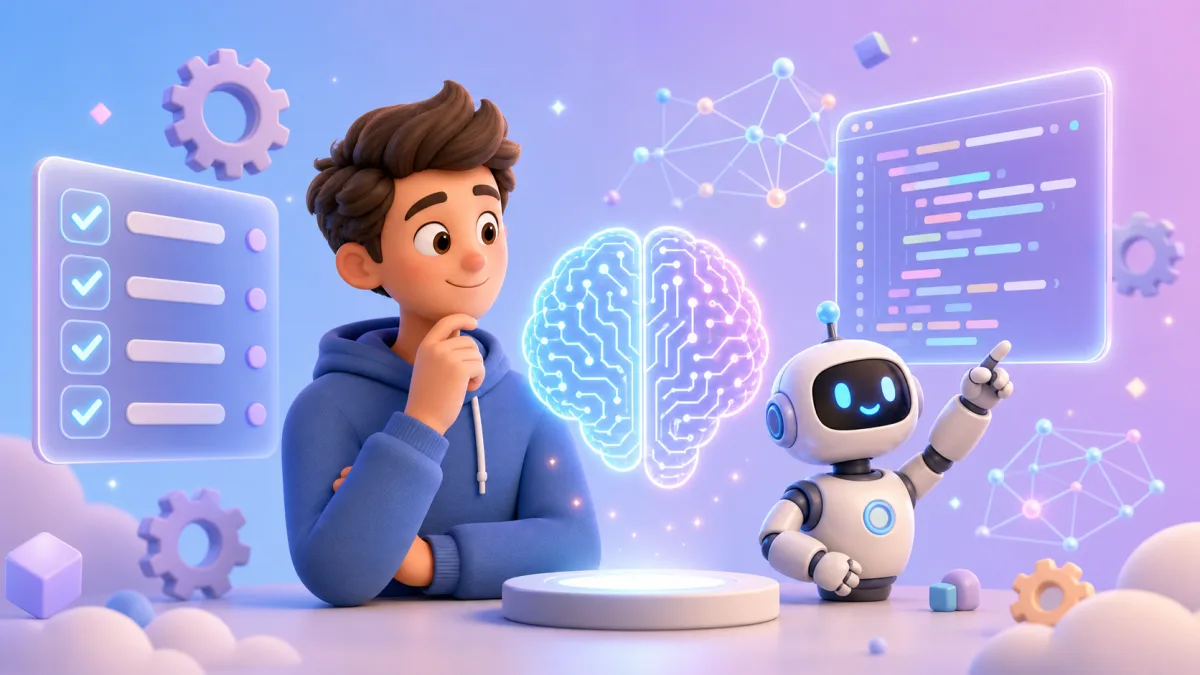
Walk into any sales call with a software agency right now, and you'll hear the same thing within the first ten minutes: "We leverage AI to accelerate development." It's in the decks. It's on the websites. It's in every response to every RFP.
The problem isn't that agencies are lying. Most of them do use AI tools. The problem is that "we use AI" tells you almost nothing about whether that agency will build your software better, faster, or more reliably than one that doesn't.
Fifty-seven percent of companies are forming new outsourcing partnerships specifically with an AI focus in 2026. The market expects AI. But clients don't have a clear framework for evaluating what AI adoption actually means — and agencies know it.
This article gives you that framework.
Why "We Use AI" Tells You Nothing
Saying your agency uses AI in 2026 is like saying your agency uses computers. It's a given, not a differentiator. The real question is how AI fits into the engineering process — and whether that process makes your project better or just cheaper for them to staff.
There are two fundamentally different ways an agency can integrate AI into development work. One benefits you. One benefits their margins while creating hidden costs for you.
Understanding which one you're looking at is the most important evaluation you can do before signing a contract.
The Two Models of Agency AI Adoption
Model One: AI as an accelerant for senior engineers
In this model, experienced developers use AI tools to move faster without compromising judgment. A senior engineer uses Copilot to scaffold boilerplate, runs an AI-assisted code review to catch edge cases, uses AI to generate test coverage on routine functions. The senior engineer still owns the architecture, reviews every generated output, and makes every meaningful technical decision.
AI here is a force multiplier. The engineer's judgment is the constant. The output is faster, and the quality is at least as high as it would be without AI — often higher, because senior attention goes to complex problems instead of repetitive tasks.
Model Two: AI as a replacement for senior engineers
In this model, the agency uses AI tools to reduce headcount at the senior level. Junior developers or even non-engineers prompt AI systems to write code, which gets reviewed superficially and shipped. The agency bills for development work but the actual engineering judgment in the product is thin.
This model cuts costs dramatically for the agency. Your quote looks competitive. But the code that ships is often poorly architected, has subtle bugs that surface later, and creates maintenance problems you'll pay for long after the project ends.
The irony is that both models look identical in a pitch deck.
Five Questions to Ask Every Agency About AI
These questions aren't trick questions. A good agency will answer them clearly. An agency that hedges or pivots to buzzwords is telling you something important.
1. Which specific AI tools do your engineers use, and at what stage?
You're looking for specificity. Tools like GitHub Copilot, Cursor, Codeium, or Claude for code generation are real answers. "We use AI throughout the process" is not. If they can't name tools and map them to specific workflow stages, they're using AI as a talking point, not a practice.
2. How does AI-generated code get reviewed before it ships?
Every legitimate engineering team has a review process. You want to know: who reviews AI output, what they're looking for, and what gets flagged versus accepted. If the answer is "our AI handles that too" or they describe a fully automated pipeline with no human judgment, escalate your concern.
3. What's the ratio of senior to junior engineers on a typical project?
This question isn't about AI directly — but it's the fastest way to understand Model One versus Model Two. A team heavy on junior developers with AI tools filling the seniority gap is a risk profile, not an efficiency gain.
4. Can you show me a project where AI helped and explain specifically how?
Concrete examples are a green flag. If they can describe a real scenario — "we used AI-generated test coverage on our e-commerce client's checkout flow, which cut QA time by 30% without reducing defect detection" — that's a team that knows what it's doing. If the example stays vague, so does the capability.
5. What does your human oversight look like when AI is involved?
This is the accountability question. What happens when AI-generated code causes a production issue? Who owns it? How is it traced? A mature team has answers. A team hiding behind AI as a shield has deflections.
What a Genuinely AI-Ready Workflow Looks Like
The agencies that are getting this right share a few common characteristics.
They have senior engineers who understand AI tool limitations — and set rules about what AI can and can't do unsupervised. AI can write unit tests for utility functions. AI cannot make architectural decisions about how data flows through a system. That line exists, and senior engineers enforce it.
They use AI to reduce time on low-judgment work — boilerplate, documentation drafts, initial test stubs — so senior attention concentrates on high-judgment work: architecture, data modeling, security design, performance optimization.
They maintain code review standards regardless of how the code was written. AI-generated code gets reviewed with the same rigor as human-written code, because the output quality is variable and context-blind in ways that humans aren't.
They can answer accountability questions clearly. When something breaks, they know which engineer owns it. AI is a tool in the process, not a party to the contract.
Stop Measuring Hours. Start Measuring Outcomes.
The older outsourcing model was built around time and materials — you paid for hours, and the deliverable was code volume. AI is breaking that model, but not in the direction most clients expect.
The shift isn't that AI makes code cheaper per line. It's that good engineers using AI can deliver better outcomes in fewer hours — and that should change what you measure.
If you're still evaluating agencies on "how many developers for how many hours," you're using a metric built for pre-AI development teams. The better metric is outcome per sprint: what working functionality is delivered per two-week cycle, and is it the right functionality built in a maintainable way?
An agency that delivers three features per sprint with clean architecture and solid test coverage is more valuable than one that delivers six features per sprint with technical debt you'll spend the next year paying off.
AI enables faster delivery. But only if it's paired with engineering judgment. That pairing — and the ability to demonstrate it — is what "AI-ready" actually means.
How TMNSolutions Approaches This
At TMNSolutions, AI tools are part of our engineers' daily workflow — not as a replacement for senior judgment, but as an extension of it. We're clear about which tools we use, how generated code gets reviewed, and where human oversight lives in every project.
We've built this into how we estimate projects, structure teams, and report progress. If you're evaluating vendors right now, we're happy to walk you through our process specifically — tools, team composition, review standards, and how we think about accountability.
The goal isn't to impress you with AI. The goal is to build software that works, ships on time, and holds up after launch. If our approach fits what you're building, let's talk.