


Why Southeast Asia Is Quietly Winning the Outsourcing Race in 2026

For most of the 2000s and 2010s, "outsourcing" was shorthand for two destinations: India and Eastern Europe. India for scale, Eastern Europe for technical depth. Both have earned their reputations. But in 2026, the global outsourcing map is being redrawn — quietly, but unmistakably.
Southeast Asia is no longer a footnote. It is increasingly a first call.
The Cracks in the Old Guard
India's outsourcing sector is under structural pressure. Rates have declined 9–16% in some segments as the market became commoditized — a predictable outcome when a market scales fast without differentiating. Mid-tier firms that once competed on price are now caught between automation (which handles low-complexity work cheaply) and the premium end (which demands specialization they can't credibly claim). Quality perception has dipped accordingly.
Eastern Europe faces a different problem: geopolitical instability and wage inflation. The Ukraine conflict disrupted delivery capacity across the region, and while Polish and Romanian talent remains strong, rates have risen significantly. The cost-to-quality argument that made the region compelling in 2015 is harder to make in 2026.
Neither region is going away. But neither retains the clear advantage it once had.
Why Southeast Asia, and Why Now
Southeast Asia's rise in outsourcing isn't a sudden discovery — it's the result of a decade of compound growth finally reaching critical mass.
Talent pool. The region's developer community has grown substantially. Vietnam alone produces roughly 57,000 IT graduates annually, a number that has doubled in under a decade. The Philippines, Indonesia, and Thailand are adding meaningful capacity too. This isn't a thin talent market anymore.
Rate stability. While India and Eastern Europe have seen rate volatility, Southeast Asia's pricing has remained stable and predictable — an underrated factor for companies that need to forecast project costs across 12–18 month engagements.
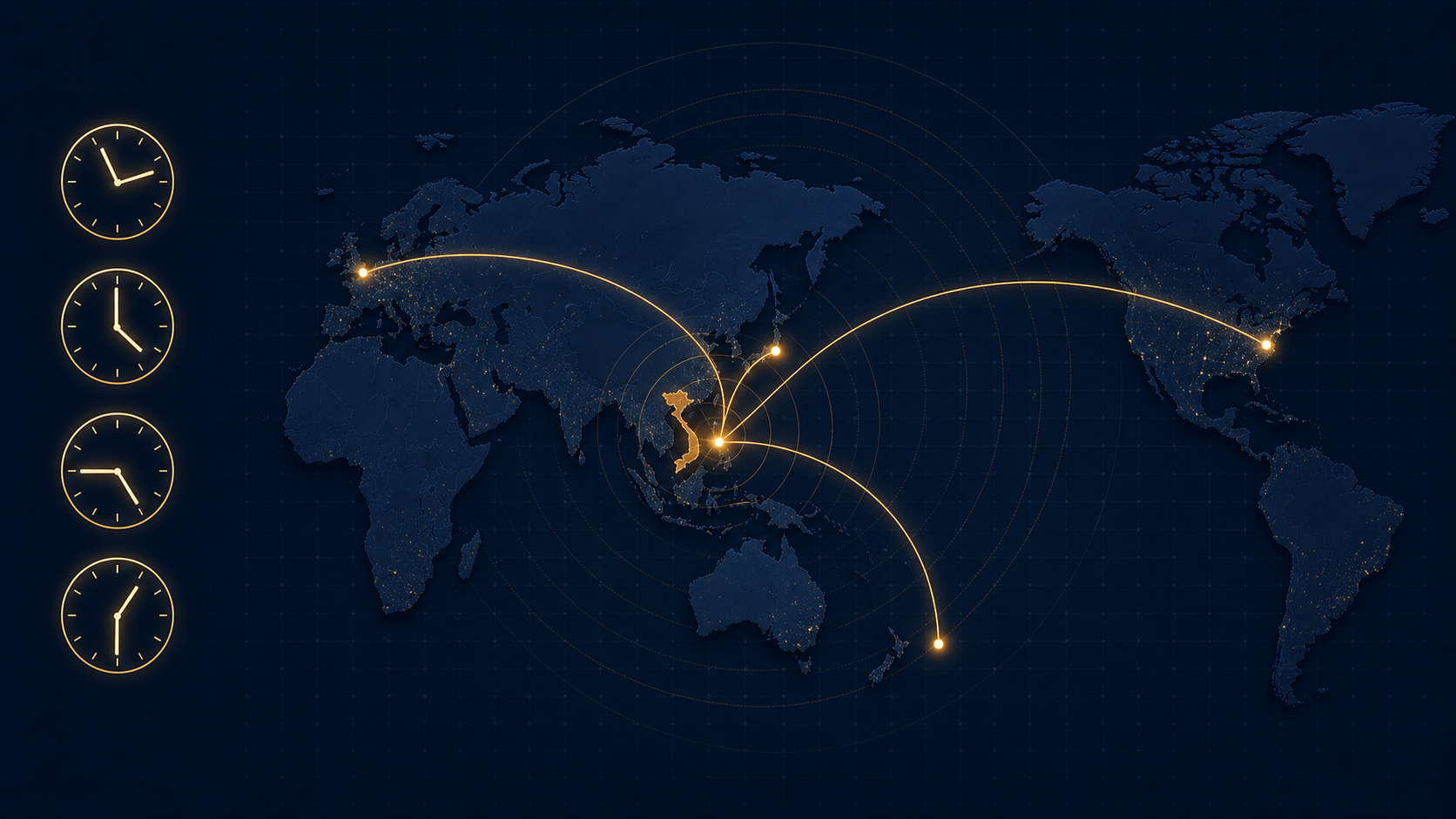
Timezone fit for APAC. For clients based in Australia, Japan, Singapore, or Hong Kong, Southeast Asia offers same-day collaboration that neither India (partial overlap) nor Eastern Europe (minimal overlap) can match. As APAC becomes an increasingly important buyer of outsourced software, this matters more than it used to.
Partial EU/US overlap. Vietnam's working hours (8am–6pm ICT, UTC+7) overlap with European mornings and US West Coast afternoons. It's not full coverage, but it's enough for daily standups and async handoffs — which is how most modern distributed teams actually work.
Vietnam Specifically
Within Southeast Asia, Vietnam has emerged as the strongest technical hub — and this isn't accidental.
The Vietnamese government has invested heavily in tech education over the past decade, establishing dedicated IT universities, funding coding bootcamps, and creating incentives for technology industry development. The result is a developer population with genuine depth: not just frontend and WordPress work, but strong backend engineering, mobile development (both native and cross-platform), and increasingly, cloud and DevOps competence.
Vietnam's Laravel community in particular is notable — the framework's adoption in Vietnam is high enough that finding experienced Laravel developers is meaningfully easier here than in most markets. For agencies building on PHP/Laravel stacks (which describes a large share of SMB and mid-market web applications), Vietnam's talent concentration is a real structural advantage.
English proficiency has also improved. Vietnam ranked 58th in the EF English Proficiency Index in 2025 — not the top of the chart, but trending upward and well ahead of what it was five years ago. Most senior engineers at established agencies work comfortably in English.
What Clients Should Actually Evaluate
Region is a shortcut, not a guarantee. Southeast Asia has excellent agencies and mediocre ones, exactly like India or Eastern Europe. If you're evaluating a SEA partner, the question isn't "is Vietnam good?" — it's "is this specific team any good?"
A few things worth examining:
Communication structure, not just English fluency. Can the agency maintain a structured delivery cadence — clear sprint reviews, documented decisions, proactive blocker escalation? This matters more than whether the lead dev speaks perfect English.
Client references from similar contexts. An agency with a track record of delivering for clients in your timezone, your industry, or your tech stack is more predictive than general credentials.
Codebase ownership practices. Understand who holds the IP, how handoffs are structured, and whether you'd receive documented, maintainable code if the relationship ended. This is where some SEA agencies (and honestly, some elsewhere) still cut corners.
Stability signals. Team tenure, agency founding date, and whether they have long-term client relationships are better predictors of reliability than portfolio screenshots.
Where TMNSolutions Fits
We're a Vietnamese software agency — and we're not neutral observers here. So it's worth being direct about what we are and aren't.
We've been building for international clients since our founding: Laravel backends, mobile apps (React Native, Flutter), WordPress platforms, and custom web applications. Our clients are in Australia, Europe, and across APAC. We work in English, we maintain Western-style delivery practices, and we've been doing this long enough to have the kind of long-term client relationships that are the real signal of reliability in this industry.
We're not the cheapest option in Vietnam. We're not trying to be. We compete on consistency, communication, and code quality — and we think those are the right axes to compete on if you're building something that has to work.
The Honest Trade-offs
We're making a case for Southeast Asia, but we'd rather make it honestly.
Language barriers exist. Even with improving English proficiency, nuanced communication — scope negotiations, conflict resolution, technical architecture discussions — can be harder across a language gap. The best SEA agencies have built processes to compensate for this. The weaker ones haven't.
IP law considerations. Vietnam's IP enforcement has improved, but it's not equivalent to what you'd find in the EU or Australia. This matters more for product companies than for agencies delivering custom work-for-hire. For most software outsourcing arrangements, proper contract structure manages this risk adequately.
Finding the right partner takes effort. The SEA outsourcing market has grown fast, and not all of the growth is quality growth. There are excellent firms and there are firms that will quote low and underdeliver. The due diligence required to separate them is real.
The Shift Is Happening
The companies paying attention to where contracts are moving in H1 2026 are noticing the same thing: Southeast Asia is capturing deals that used to go elsewhere. Not because it's cheaper (the rate gap has narrowed), but because the quality-to-reliability-to-timezone equation is increasingly favorable.
This isn't about Vietnam replacing India or Poland. It's about a more distributed outsourcing market where the old defaults aren't automatic anymore — and where a well-run agency in Ho Chi Minh City is a legitimate first choice, not a fallback.
For companies evaluating their outsourcing options, the calculus has changed. The question is whether you're updating your assumptions to match the reality on the ground.