



The Real Cost of a 10-Hour Time Zone Gap (And Why Vietnam Sits in a Sweet Spot)
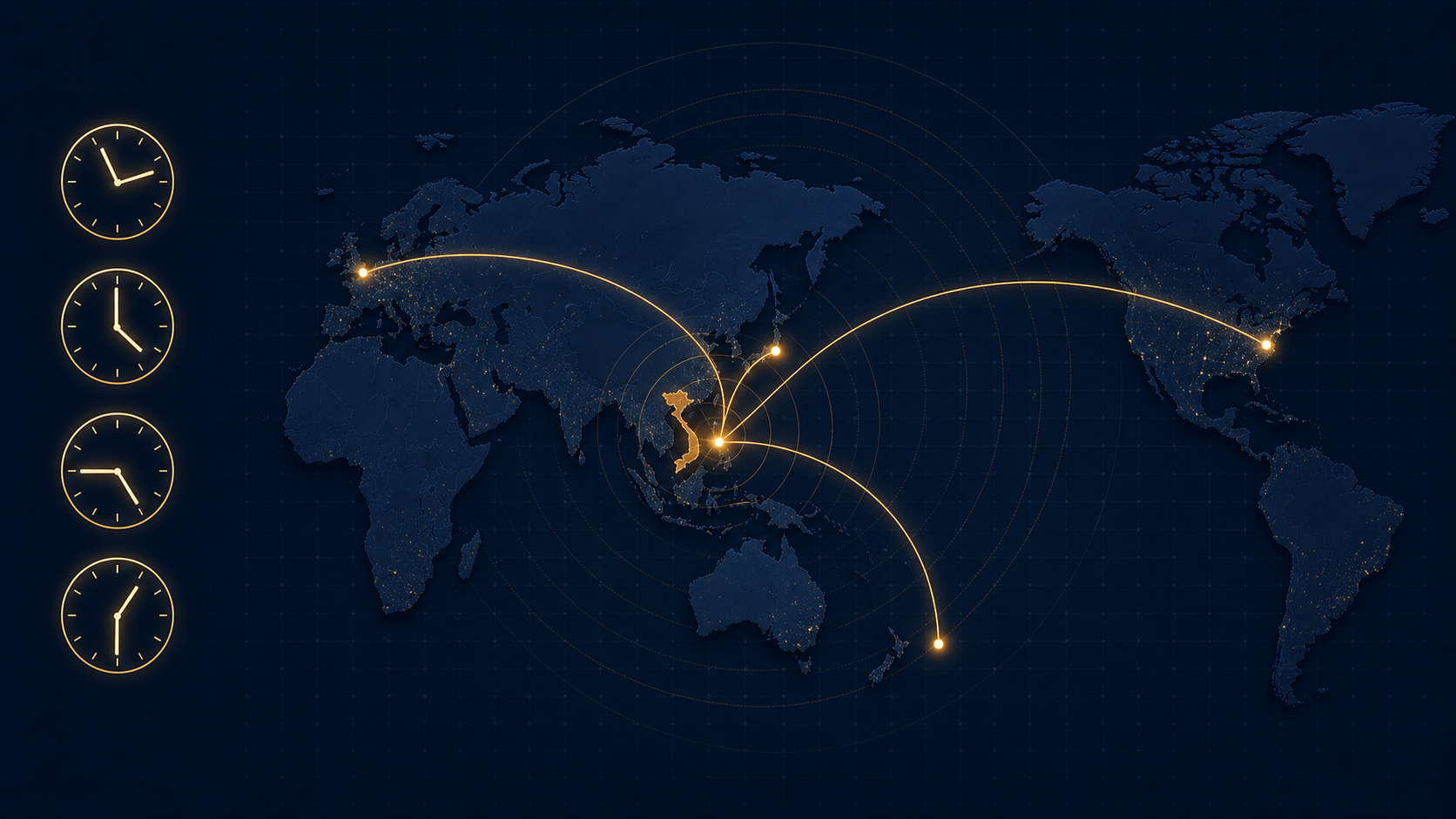
The pitch is familiar: offshore development, 50–70% cost savings, access to skilled engineers. The brochure math is clean. The reality is messier.
What the savings calculation rarely includes is the cost of time. Not developer time — calendar time. The days that pass between a question asked and an answer received. The sprint cycles where a blocked ticket waits eighteen hours for a three-line clarification. The production bug that surfaces at 3pm your time and does not get looked at until your next morning.
Time zone distance is a hidden tax. When it is 10 hours or more, that tax starts to cancel out the savings.
The Hidden Costs of a Large Time Zone Gap
Most outsourcing cost comparisons focus on hourly rates. That is the wrong unit of measure.
The real cost drivers in a distributed team are cycle time — how long decisions take — and blocking events — how often one team cannot move forward because it is waiting on the other.
A 10-hour gap means:
- Zero same-day overlap. There is no window where both sides are at their desks at the same time. Every communication becomes asynchronous by default.
- Overnight blocking. A question posted at 5pm your time reaches the offshore team at 3am theirs. Their answer lands back at your 11pm. By the time you respond and they act, two calendar days are gone.
- Extended feedback loops. Code review comments, QA clarifications, requirements questions — anything that requires a back-and-forth exchange takes days instead of hours.
- Incident response gaps. Production issues do not respect business hours. A critical bug at 4pm EST hits at 2am Vietnam time — manageable. The same bug at 4pm PST hits at 7am UTC+8 — the team is just starting their day. But a 4pm London issue at +10 hours means there is no coverage window for many hours on either side.
None of this shows up on a rate card. All of it shows up in your delivery schedule.
The Sprint Math
Let us put numbers to it. Assume a two-week sprint with daily standups.
In a co-located or low-gap team (0–3 hours), a blocked ticket typically resolves in a few hours. Developers can ping each other, get a quick answer, and keep moving. Effective blocking time per ticket: 2–4 hours.
In a 10-hour gap scenario, the same blocked ticket waits for the async cycle. Effective blocking time per ticket: 18–36 hours — that is, one to two full calendar days before the blocker is resolved and work resumes.
In a typical sprint, three to five significant blockers is normal. At 18–36 hours each, you lose 3–7 calendar days per sprint to async delay — on a 10-day sprint, that is 30–70% of your delivery window absorbed by time zone friction.
The 60% cost savings has a compounding overhead attached to it that does not appear in any line item.
Vietnam's Time Zone Position
Vietnam sits at GMT+7. That sounds like a number — it is actually a strategic position on the global collaboration map.
With Singapore and Southeast Asia: Near-zero gap. Same-day collaboration, real-time communication, shared business culture. This is the home market, and it works frictionlessly.
With Japan and South Korea (GMT+9): Two-hour gap. Workday overlap of 6–7 hours. Japanese companies regularly partner with Vietnamese teams and run synchronous meetings without issue — which is why Japan has become one of the largest buyers of Vietnamese IT services.
With Australia (AEST, GMT+10): Three-hour gap. Sydney's morning aligns with Vietnam's early afternoon. Teams can hold daily standups, run collaborative review sessions, and maintain a genuine working relationship across the timezone boundary.
With Western Europe (CET, GMT+1 to GMT+2): Five to six hours behind Vietnam. The European morning (9am to noon) aligns with Vietnamese afternoon (2pm to 5pm or 6pm). Four to five hours of overlap is enough for standups, sprint ceremonies, and escalation paths. Not frictionless, but very workable.
With US East Coast (GMT-4 to GMT-5): Eleven to twelve hours. This is the hardest gap. But it is asymmetric in a useful way — Vietnam's morning (8am to noon) aligns with US East Coast evening (9pm to 1am). For async-first teams that have learned to front-load their communication, this creates a functional handoff pattern: US team ends their day with questions and decisions; Vietnam team picks them up at the start of their day and delivers updates before the US team starts again. It is not seamless, but it is structured.
With US West Coast (GMT-7 to GMT-8): Fourteen to fifteen hours. This is genuinely difficult. Meaningful overlap is essentially nonexistent during standard business hours. This gap requires significant process investment to manage — and the calendar cost of that investment should be part of the calculation.
The 2025–2026 Context: H-1B and the Reshuffling Map
The outsourcing geography is shifting. Changes to H-1B visa policy in 2025–2026 have tightened the pipeline of foreign-born technical talent working onshore in the United States. Companies that relied on a blend of in-house and visa-sponsored contractors are reassessing their options.
The immediate pressure has pushed some buyers toward nearshoring — Latin America for US West Coast, Eastern Europe for Western Europe. But senior developer capacity in these markets is limited, and rates have risen significantly as demand has spiked.
Vietnam is an alternative that does not always make the shortlist — often because the time zone perception is "too far from the US." That perception deserves a harder look. For East Coast companies with async discipline, and for European and APAC companies across the board, the gap is manageable. The talent depth is real. And the rate advantage has not evaporated the way it has in some nearshore markets.
The question is not whether Vietnam is far from San Francisco. The question is whether your development workflow is designed to make geographic distance work for you or against you.
A Framework for Evaluating Time Zone Fit
When evaluating an offshore or nearshore vendor, time zone fit should be a structured question — not an afterthought.
Step 1: Map your actual collaboration patterns. How much of your current development workflow is synchronous versus asynchronous? Daily standups, sprint planning, code reviews, QA sign-offs — which of these require real-time interaction and which can be async?
Step 2: Calculate your overlap window. How many hours per day do your two teams share workday time? Less than two hours is effectively zero for practical purposes. Two to four hours is workable for ceremonies. Four-plus hours enables genuine daily collaboration.
Step 3: Count your blockers per sprint. Look at your last three sprints. How many tickets were blocked waiting for input from another party? Multiply that by the expected resolution time under the gap you are evaluating.
Step 4: Price the calendar cost. If three blockers per sprint each cost an extra day under a 10-hour gap, and you run six sprints per quarter, that is eighteen calendar days of delay per quarter — equivalent to almost three developer weeks. What does that cost at your current burn rate?
Step 5: Evaluate the vendor's async discipline. Does the vendor have documented communication protocols for async work? Do they use structured handoff notes? Is their project management tooling configured to minimize synchronous dependencies? A vendor who has thought about this will have answers. One who has not will tell you "we are flexible."
"We are flexible" is not a communication strategy.
What This Means for Vietnam-Based Teams
At TMNSolutions, GMT+7 is not a constraint we apologize for — it is a position we have built around.
For our APAC and Japanese clients, we operate in near-real-time. For our European clients, afternoon overlap handles the critical touchpoints. For our US East Coast clients, we run structured async: end-of-day summaries, beginning-of-day updates, and clearly documented decision queues so nothing waits in ambiguity.
Time zone alignment is not just about geography. It is about whether the vendor has built a workflow that makes the geography work. The gap does not disappear — but with the right process, it stops being the thing that eats your schedule.
The outsourcing calculation has always been more than a rate card. The teams that figure out how to make distributed collaboration functional — not just cheap — are the ones that deliver.
Vietnam's position at GMT+7 puts it within workable range of most of the world's major tech markets. That is the case. The rest is execution.