


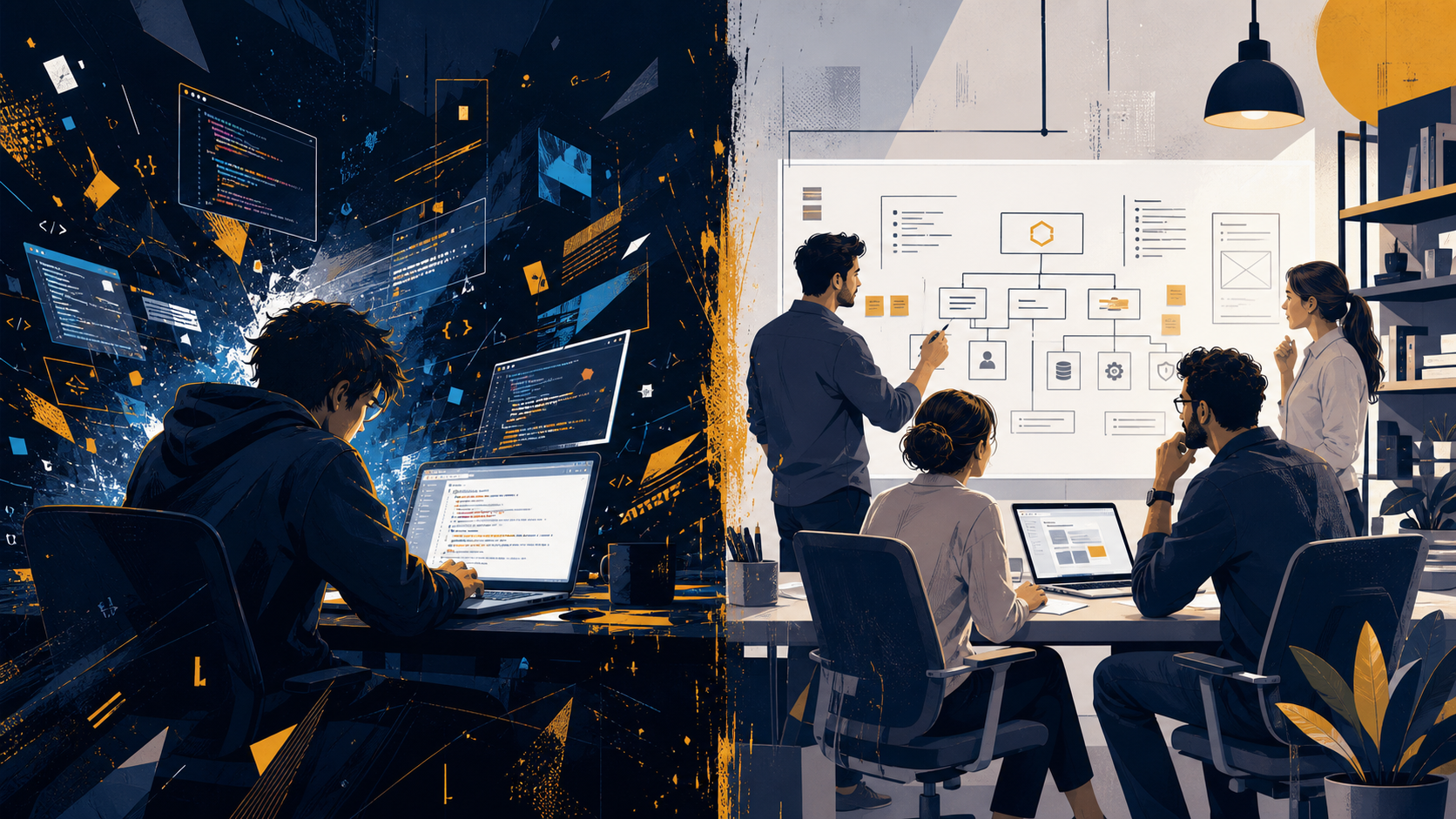
There is a moment, usually around hour three of prompting Cursor or Lovable, when it feels like magic. You described what you wanted in plain English, and there it is — a working interface, a login screen, maybe even a database. No developer hired. No meetings. No timeline.
This is vibe coding, and it is genuinely impressive. It is also genuinely incomplete.
In 2026, vibe coding is no longer a novelty — it is a workflow. Founders use it for MVPs. Marketers use it for internal tools. A school district in the United States saved $200,000 by building custom ed-tech with AI instead of purchasing off-the-shelf software. The trend is real, the productivity gains are real, and it is not going away.
But a recent study by RedAccess found something worth paying attention to: among 380,000 vibe-coded apps analyzed, roughly 5,000 exposed sensitive corporate or personal data on the open web. Patient records. Financial information. API keys sitting in frontend code. Not because the developers were careless — there were no developers. There was just a prompt, an AI, and a deployment button.
The question is not whether vibe coding works. It clearly does, for certain things. The question is: what exactly does it not do?
What Vibe Coding Is Actually Good At
To be fair: vibe coding excels at speed and accessibility. It removes the barrier between having an idea and having a working prototype. For internal tools, quick demos, and early-stage MVPs where the goal is simply to see if the concept holds — it is hard to beat.
It also puts non-technical founders in control of their product direction in ways that were impossible five years ago. That matters.
What Vibe Coding Does Not Do
Here is the honest list:
It does not think about the future. AI generates code that satisfies the prompt in front of it. It does not ask: what happens when you have 10,000 users instead of 10? How will this integrate with your accounting system next year? What does the data model look like when the product pivots? An agency does. That conversation happens before a single line of code is written.
It does not own the outcome. When an AI-built app breaks in production, there is no one to call. No SLA. No accountability. The model that generated your code cannot be held responsible for your downtime. A development agency can — and good ones structure their engagements so that responsibility is explicit.
It does not understand your business. Good software is not a collection of features. It is a product built around how a specific business operates, who its customers are, and what they actually need to accomplish. An agency that takes the time to understand your context will make architectural decisions that serve you for years. An AI makes decisions that satisfy the prompt.
It does not handle security. This is the most serious gap. Security is not a feature you add at the end — it is baked into how authentication is designed, how data is stored, how APIs are structured. AI-generated code is trained on public repositories, which means it learns both good and bad patterns. Without a human reviewing the output, you are shipping whatever the model produced. The 5,000 exposed apps are proof that this is not a theoretical concern.
It does not maintain. Shipping is one thing. Keeping software running, updated, and compatible with evolving dependencies is another. Vibe-coded apps do not come with a maintenance plan. Agencies do.
The Real Cost of "No Developer"
Vibe coding feels cheap upfront. And often it is — for the initial build. The cost appears later: when the codebase becomes unmaintainable, when a security vulnerability surfaces, when the business outgrows what the prototype can handle, and there is no engineer who understands the system well enough to fix it.
Rebuilding from scratch is expensive. Cleaning up a security incident is expensive. Losing a client because your system went down at the wrong moment is expensive.
Professional development costs money because it avoids a different, larger bill down the road.
What Agencies Bring That AI Cannot Replicate
A development agency brings judgment. Not just code — judgment. The ability to push back on a brief that will lead to the wrong architecture. The experience to know that the feature the client asked for is not the feature they actually need. The discipline to write code that someone else can read and maintain two years from now.
Agencies also bring accountability. There is a contract, a team, a point of contact. When something goes wrong — and in software, something always goes eventually — there is a relationship and a process for resolving it.
At TMNSolutions, we work with businesses that have tried vibe coding. Sometimes they come to us with a prototype they built themselves and want to take to production. Sometimes they come after a rebuild that did not survive real traffic. In both cases, the conversation is the same: what do you actually need this to do, who will use it, and how do we build it so it is still serving you two years from now?
That conversation is not something you can have with a prompt.
The Right Tool for the Right Job
This is not an argument against vibe coding. Use it for internal dashboards, quick experiments, and proof-of-concept prototypes. It is genuinely useful for those things.
But if you are building something that customers depend on, something that handles their data, something your business is staked on — that is not the place to skip the professional.
The agencies that thrive in the age of vibe coding are the ones that embrace AI tools while holding the line on the things AI cannot provide: architecture, accountability, security, and long-term thinking.
Those things are not going to be automated away anytime soon.